


Meet the curious billionaire who began life as a refugee - and brought the Bayeux Tapestry to Britain
Meet the curious billionaire who began life as a refugee - and brought the Bayeux Tapestry to Britain

Geordie Greig Fri, October 16, 2026 at 7:54 AM UTC
0
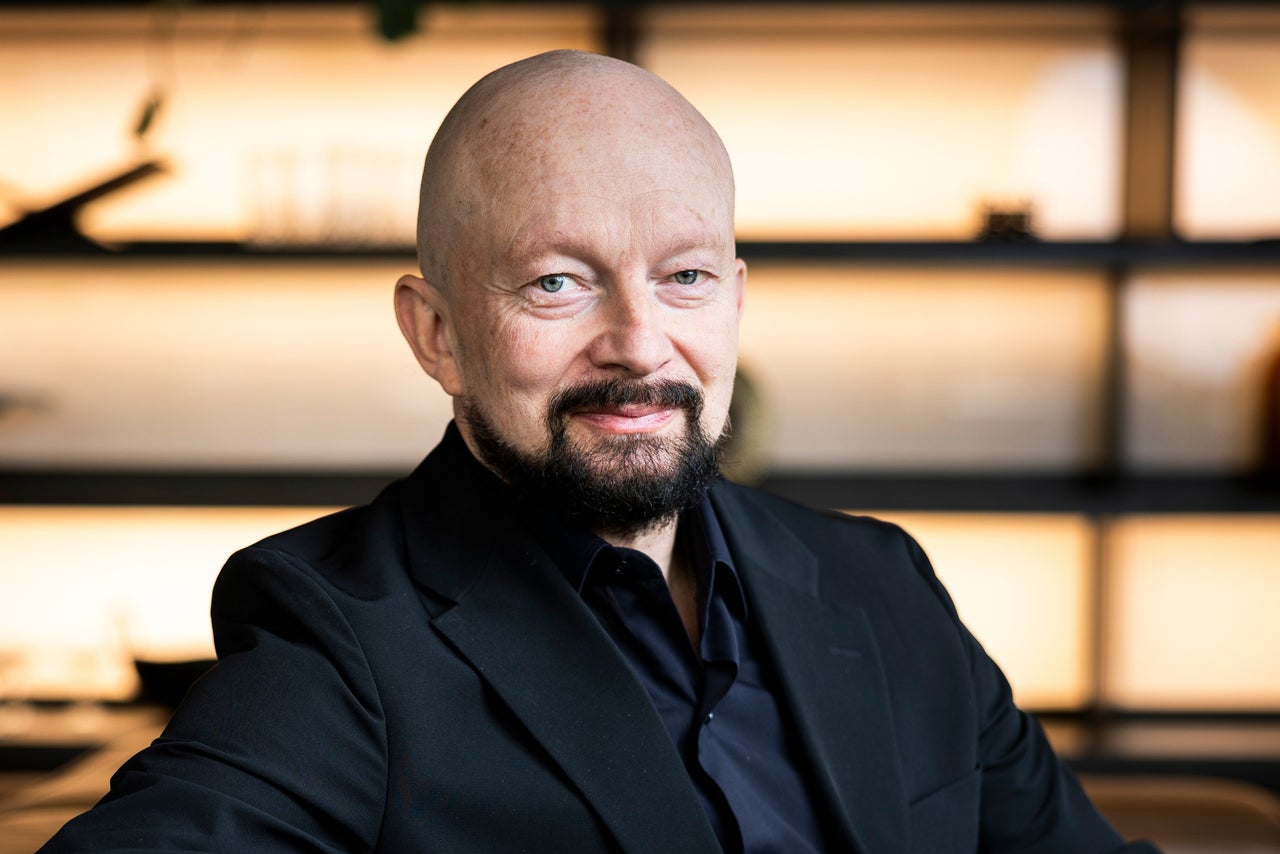
IN FOCUS: The Belarus-born American who learnt English from watching TV spoke to The Independent’s editor-in-chief Geordie Greig about his extraordinary life and what drove him to become one of the most prominent arts patrons of his generation
The lights are low in the British Museum when Igor Tulchinsky slips quietly into the room. There is no swagger, no entourage, no theatrical display of wealth. Slight, with a close-cropped beard and warm, enquiring eyes, he is dressed almost entirely in black, his leather jacket bearing the WorldQuant logo. He has the air of a man who would rather look than be looked at.
Observation is his instinct. He watches, asks questions, absorbs information and only then decides. It is a habit formed early, when, aged 11, he left the Soviet Union with his Jewish parents in search of a life beyond communism, antisemitism and the grey monotony of a society that offered little freedom or possibility.
Today, the Belarus-born American is a self-made billionaire and one of the most prominent arts patrons of his generation. He has committed £5 million to the British Museum’s exhibition of the Bayeux Tapestry, one of the most anticipated cultural events since the Tutankhamun exhibition of the 1970s. Yet he seems less a tycoon surveying his investment than a man encountering something new. He is global philanthropist having founded the first digital university and giving tens of millions of dollars to endow universities. He also donated to Refuge when the Independent campaigned for homes for victims of domestic abuse.
He leans towards the tapestry. Nearly a thousand years old, the embroidered linen stretches for almost 70 metres, recounting the drama of 1066 in coloured wool. In the subdued light, it resembles a primitive strip of cinema. Horses rear, ships cross the sea, messengers carry news and armies prepare for battle. Harold Godwinson takes an oath; William of Normandy readies his invasion; then the killing begins.
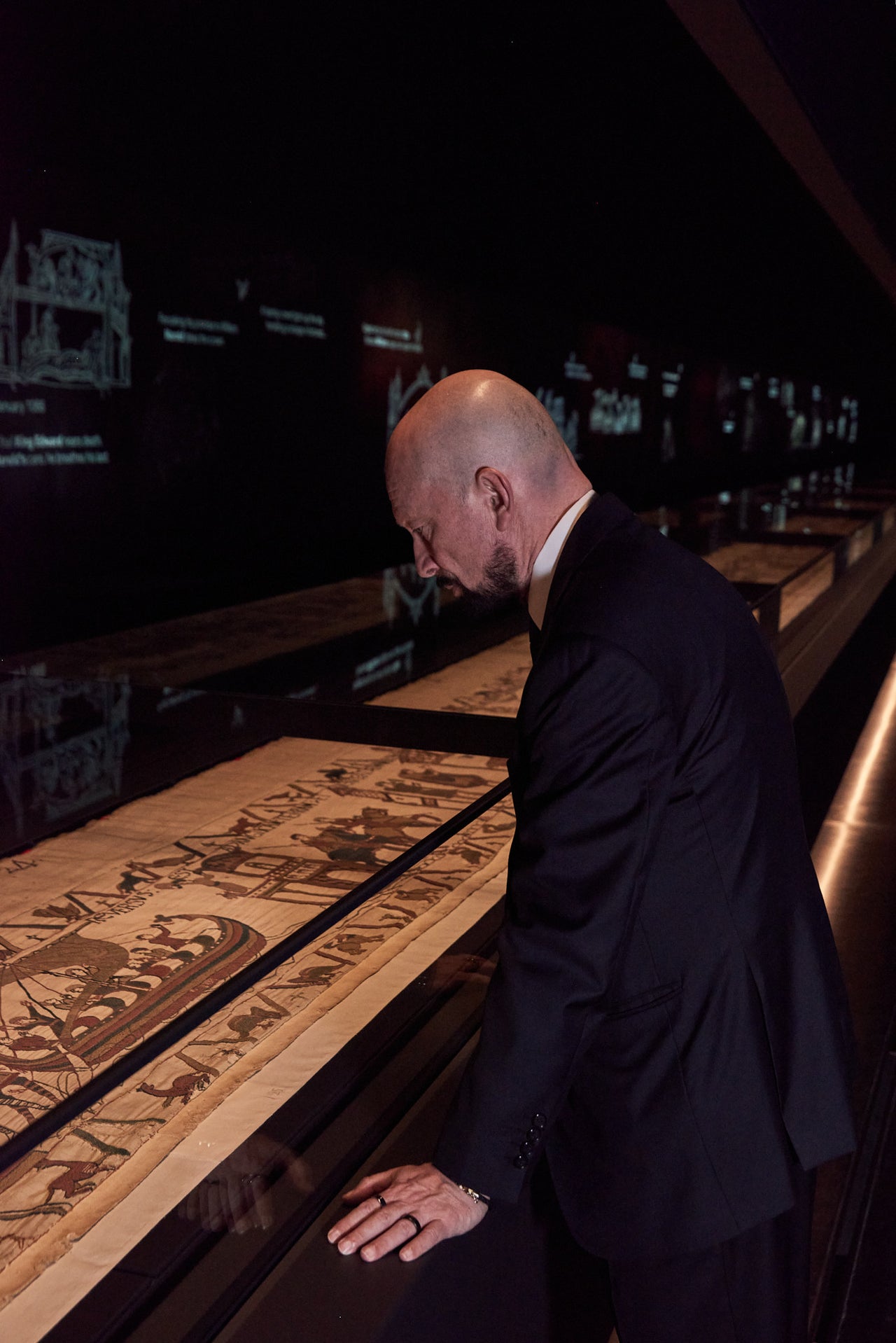
Igor Tulchinsky is fascinated by the Bayeux Tapestry (WorldQuant)
Tulchinsky studies it with almost childlike absorption. “I was struck by how new it looked,” he says, admiring the composition and the visual rhythm of its three horizontal registers. “It’s very visceral.”
He had not anticipated quite how cinematic it would be. “It tells a story in pictures,” he says. “Pictures [are] a thousand words.”
He is interested in who moves, who watches, who knows what is coming and who does not. The tapestry is a story of migration, calculation, chance and conflict; it is also a study in how people interpret information and act upon it. Few works could offer a more fitting introduction to a man whose own life has been shaped by movement and decisions made under uncertainty.
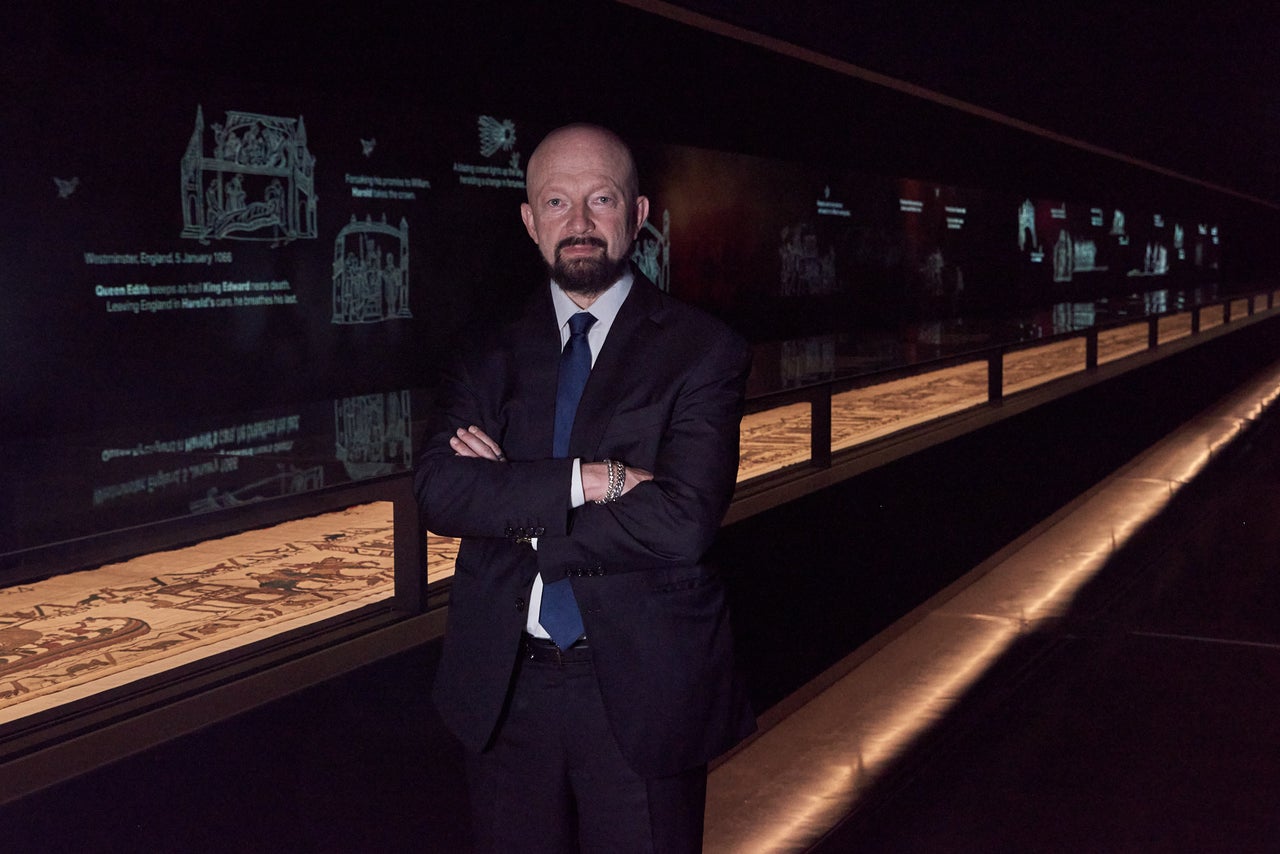
Igor Tulchinsky committed £5million to the project to bring the Bayeux Tapestry to the British Museum (WorldQuant)
Tulchinsky’s parents were musicians. His father played the viola, his mother the piano and taught at a music school. They practised for hours each day, filling the family home with classical music. Although Tulchinsky never became a musician, it remained part of his intellectual landscape.
The family’s departure was neither an adventure nor an exercise in ambition. They wanted their only child to have a future they could not offer him in the Soviet Union. As Jews, they faced persistent antisemitism. “There were names called and chalk on the pavement,” he recalls. He learnt to keep his head down and avoid drawing attention to his identity.
Leaving was itself a risk. A Jewish organisation helped people emigrate, but applying for permission could mark a family as traitors. Refusal might cost his parents their jobs. They waited three or four months to discover whether they would be allowed to go.
At first, Tulchinsky resisted. He was 11, with friends and a familiar world he did not want to abandon. His parents, however, saw the choice in stark terms: darkness or light, deprivation or opportunity. They decided to stake everything on their son’s future.
The family travelled first to Vienna, then Italy, where they applied for refugee status in the United States, Australia and Canada. Money was scarce, and they sold possessions from their suitcases to survive. In a suburb of Rome, they stayed with a shoemaker. Tulchinsky remembers his father practising his viola while the shoemaker worked; when the music stopped, the hammering resumed.
Eventually, the family secured refugee status and flew to New York. Their first accommodation was a grey-stone hotel on the Upper West Side, where they stayed for two or three weeks. Tulchinsky remembers the cockroaches, which he describes as “humongous”, and the almost complete absence of English.
American television became his first language teacher. The family watched because they had to learn, and because immersion was the quickest route into a new world. Within a year, he could understand everything being said.
They moved to Astoria, Queens, settling in government-subsidised housing in a rough neighbourhood. His school had broken windows; furniture came from discarded belongings that were still clean enough to use. He carried a small dictionary to help with his homework.
It was an early education in resourcefulness: observe, absorb, work things out and find a solution. Complaining was of little use.
He also learnt that opportunity was unevenly distributed. One of his closest friends in Queens was Puerto Rican. Their circumstances were similar, but their lives diverged dramatically. Tulchinsky moved upwards through education and business; his friend remained in the neighbourhood.
The family’s experience was framed by an older, more harrowing history. During the Second World War, his paternal grandmother fled Belarus for Siberia while pregnant. She went because the Germans were unlikely to reach her there. Tulchinsky’s father was born in Siberia and did not see his own father until he was five. His grandmother understood the distinction between migration and war: immigration was difficult, she believed, but war was harder to survive. Tulchinsky has never forgotten that perspective.
His early academic record was unremarkable. He admits that he did not initially work particularly hard, and his grades reflected it. Then the family moved to Richmond, Virginia, where he sat an entrance examination for a good Catholic school and won a scholarship. Competition sharpened his ambition, and he rose to become the second-best student academically.
Mathematics and programming soon offered a different kind of education. Much of his technical knowledge came from computer manuals, first on an Apple and later on a Commodore 64. He taught himself BASIC, graphics and game design, learning by experimenting with systems and discovering their rules.
His first 20 jobs were less a conventional career ladder than a series of stepping stones. He made a card catalogue for a private library, washed dishes, prepared sandwiches, worked at a computer camp for disabled children, tutored English and held retail jobs at Target and Service Merchandise. He programmed software for hospital antibiotic dosages, designed computer games and wrote books, often studying while working and working while studying.
One employer gave him a list of names and asked him to turn them into games. One was called Blow the Whistle, a miniature football simulation with three players on each side. To Tulchinsky, the important element was not the entertainment but the underlying model. “It’s basically simulation,” he says.
The idea would prove foundational: understand a system, identify its rules and test what happens when they change.
At 18, he applied to an oil company and took a programming test. A month passed without a response, until an executive called to say he had never seen anyone programme like that. Tulchinsky went on to build the company’s general ledger, having acquired the necessary skills largely on his own.
At Bell Labs, he worked while completing a master’s degree that was supposed to take two years. He finished in nine months and, without immediately telling his employers, took three months of unpaid leave. But the slow bureaucracy of telephone-system programming soon frustrated him. Three lines of code a day, he recalls, was intolerable.
Advertisement
He began exploring other possibilities, taking the LSAT and GMAT and considering law school and business school. Traditional recruitment proved less successful. He was not as polished in interviews as the candidates competing for consulting and investment-banking jobs.
So he changed the method. He sent thousands of letters to chief executives, reasoning that a thousand letters might produce ten interviews and one or two offers. The calculation was simple, and it worked.
One letter led to the Harvard Institute for International Development and an assignment in Moscow, where he worked on privatisation. He became convinced that the system was compromised and decided to leave. One night, he walked away; two hours later, he was gone.
It was an early expression of a principle that would become central to his thinking: knowing when to cut your losses.
Tulchinsky subsequently worked for Thomas Peterffy, developing trading strategies, before joining Millennium. There he built quantitative frameworks and helped develop international research capabilities. The boy who had learnt English from television had become a man whose professional language was mathematics.
In 2007, he spun WorldQuant out of Millennium. The business expanded across China, India, Israel, Hungary, Romania, Bulgaria, Vietnam, Singapore, South Korea and other markets. Today, he says, it has 28 offices in 18 countries, with Uruguay the latest addition. Its premise reflects a conviction formed long before he entered finance: talent is universal, but access to opportunity is not.
Quantitative investing also taught him the difference between intelligence and survival. In 1998, after Russia defaulted on the rouble, a pair-trading strategy he believed in lost heavily. He went into the red and spent more than a year recovering. His father advised him to quit. He persisted.
Then came the quant crisis. Tulchinsky recalls liquidating positions a day before the steepest fall and re-entering partway through the following day. Had he waited another day, he believes, the losses could have wiped him out.
The lesson was unequivocal: preserve the capital.
“When I’m scared, I run,” he says.
It is a strikingly unvarnished admission from a billionaire investor. There is little of the familiar mythology in which every decision becomes, in retrospect, an act of genius. Tulchinsky gives luck a substantial share of the credit. Asked to divide success between intelligence and luck, he puts it at “50-50”.
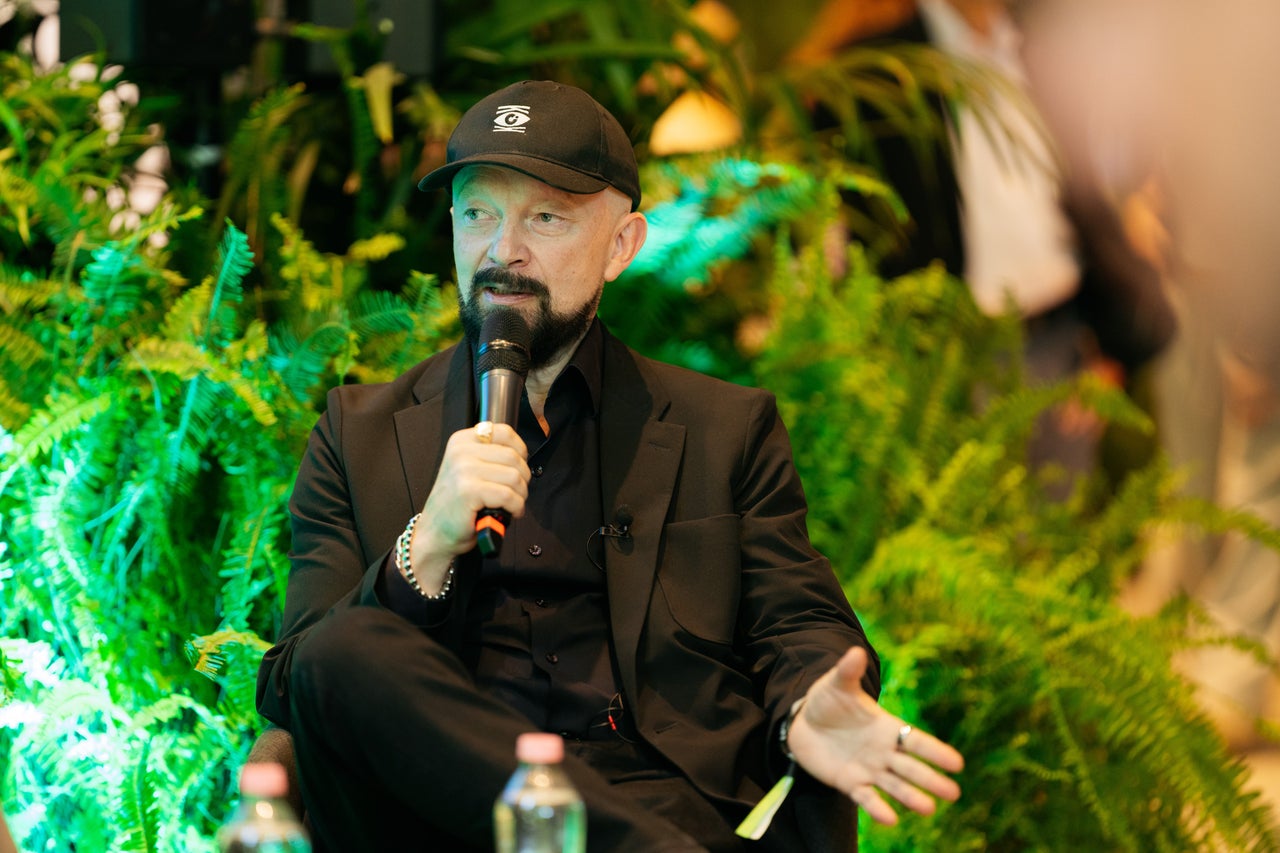
The self-made billionaire attributes his success to 50-50 luck and intelligence (WorldQuant)
Wealth has given him something more valuable than the ability to accumulate further wealth: the freedom to choose what comes next. “Mainly, what changes [is] that you can do philanthropy the way you want to,” he says.
His first philanthropic commitments centred on scholarships, supporting disadvantaged students at universities in the United States and Israel. He also funded academic institutions and research, including a major endowment connected to Cornell.
But scholarships, he came to believe, addressed only part of the problem. If education had transformed his own life, why not expand access on a much greater scale? The question led him towards building a digital university, principally focused on Africa.
The ambition is consistent with his own experience. He arrived in America barely speaking English, acquired a language, gained an education and developed technical skills. Each new capability opened a door to the next opportunity. Education was not an ornament to success; it was the engine.
A digital university could challenge the assumption that geography should determine access to intellectual opportunity. A talented young person born far from an elite institution should not necessarily be excluded from the knowledge and networks that might change a life.
Here, his philanthropy becomes an extension of his biography. He is not merely redistributing the proceeds of one successful system; he is trying to build another, in which more people can learn, compete, experiment and try again.
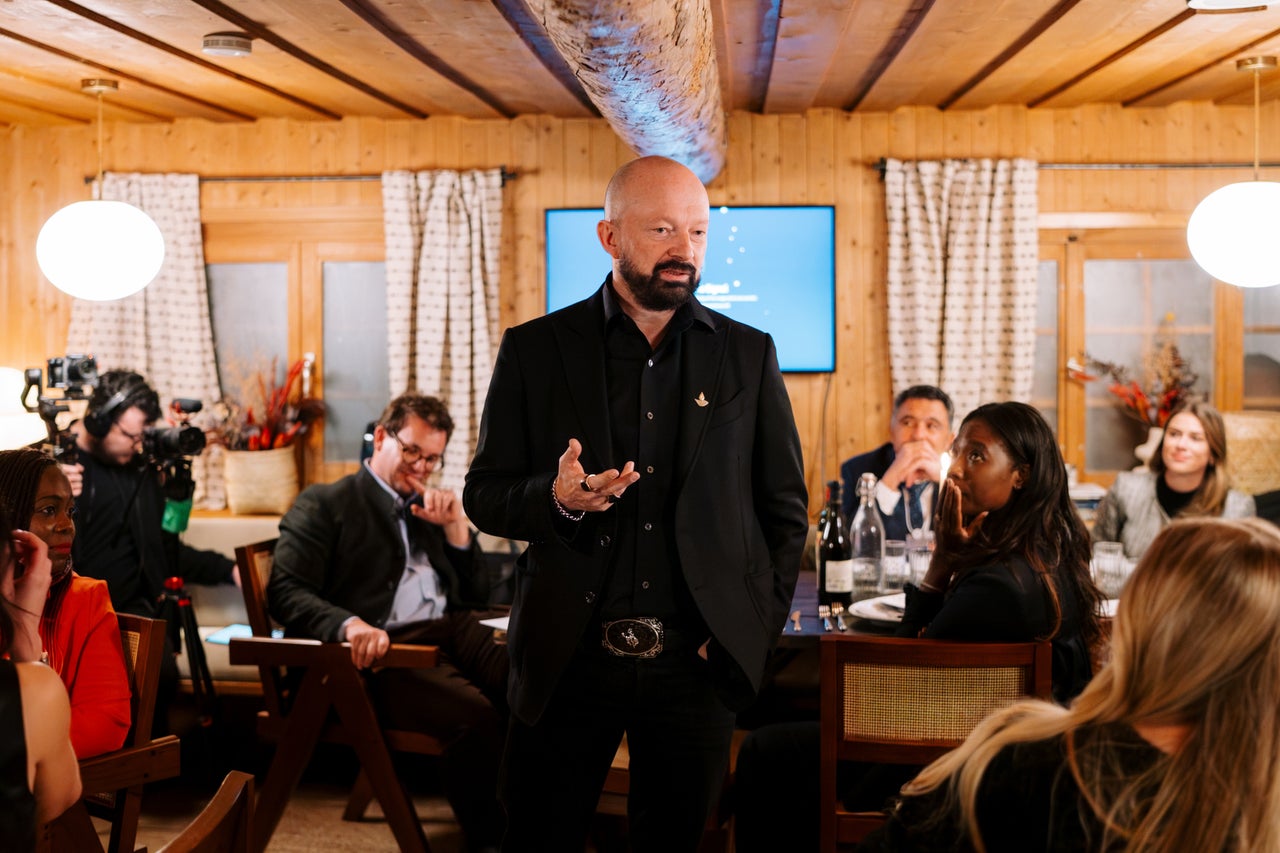
Igor Tulchinsky in Davos (Joe Short)
Tulchinsky’s life has not followed a grand strategic plan. “It came about as a sequence of tactical moves rather than strategic,” he says. Each day, he explains, you do whatever takes you closer to your goals.
Those goals have remained consistent: a certain amount of money, a certain amount of alpha, a certain amount of capital and a certain amount of philanthropy. The details change; the underlying method does not.
He is now writing a book, Cutting Losses, about recognising when something is no longer working and knowing when to stop. His life, he says, changes according to what he cuts. The challenge is to distinguish persistence from stubbornness, and ambition from attachment to a failing idea.
That combination of curiosity and pragmatism is what makes the Bayeux Tapestry such an apt encounter. Its grand narrative is one of kings, conquest and the making of England, but its details reveal a more uncertain world of messengers, individual risks and decisions taken without knowing the outcome. History, like markets, is shaped by the interaction of information, judgement and chance.
Tulchinsky recognises something familiar in that uncertainty. His own journey has depended less on a single master plan than on a succession of decisions: to leave, to learn, to try a different route, to persevere when the odds seemed unfavourable and to retreat when the risks became too great.
Back in the museum, he continues to study the tapestry. A man who built his fortune by searching for patterns in vast quantities of information is still drawn to the details others might overlook.
Has his search for the next opportunity finally ended?
“No,” he says. “I’m still looking.”
Source: “AOL Entertainment”
