


Powerful aftershock hits Indonesian communities still waiting for aid as earthquake death toll rises to 68
Powerful aftershock hits Indonesian communities still waiting for aid as earthquake death toll rises to 68

Stuti Mishra Mon, August 17, 2026 at 10:38 AM UTC
0
The death toll from Saturday's earthquake in Indonesia has risen to at least 68, as powerful aftershocks continued to strike fear into communities on the island of Flores where thousands of people are still waiting for aid.
A magnitude-5.9 tremor was recorded at a depth of about 10km by Germany's GFZ Research Centre for Geosciences on Monday, though there were no immediate reports of further casualties.
The agency has recorded at least 995 aftershocks since Saturday, 46 of which were powerful enough to be felt by residents. The strongest before Monday's measured 6.2.
Indonesia on Monday marked its 81st Independence Day, which residents of Flores spent mourning, searching for relatives and waiting for supplies to reach them.
President Prabowo Subianto asked the nation to pray for people affected by the disaster in East Nusa Tenggara and other parts of the country, as well as leading a nationwide moment of silence honouring Indonesia’s independence heroes.
The province's governor declared a 14-day state of emergency on Sunday, with the earthquake death toll continuing to climb as rescue teams work through debris. Officials expect it to rise further as they reach more villages cut off by landslides. Most of the deaths were recorded in the districts of Sikka, Manggarai and East Manggarai.
The magnitude-7.7 earthquake that struck on Saturday morning had its epicentre about 68km north-west of Ende, a town on the south coast of Flores, according to the US Geological Survey.
Flores lies in East Nusa Tenggara, a province of scattered islands at the eastern end of the Indonesian archipelago.
At least 200 people were injured and more than 2,000 homes were damaged across East Nusa Tenggara province, nearly 250 of them destroyed on Flores alone, the National Disaster Management Agency said. About 5,000 people are in temporary shelters.
Advertisement
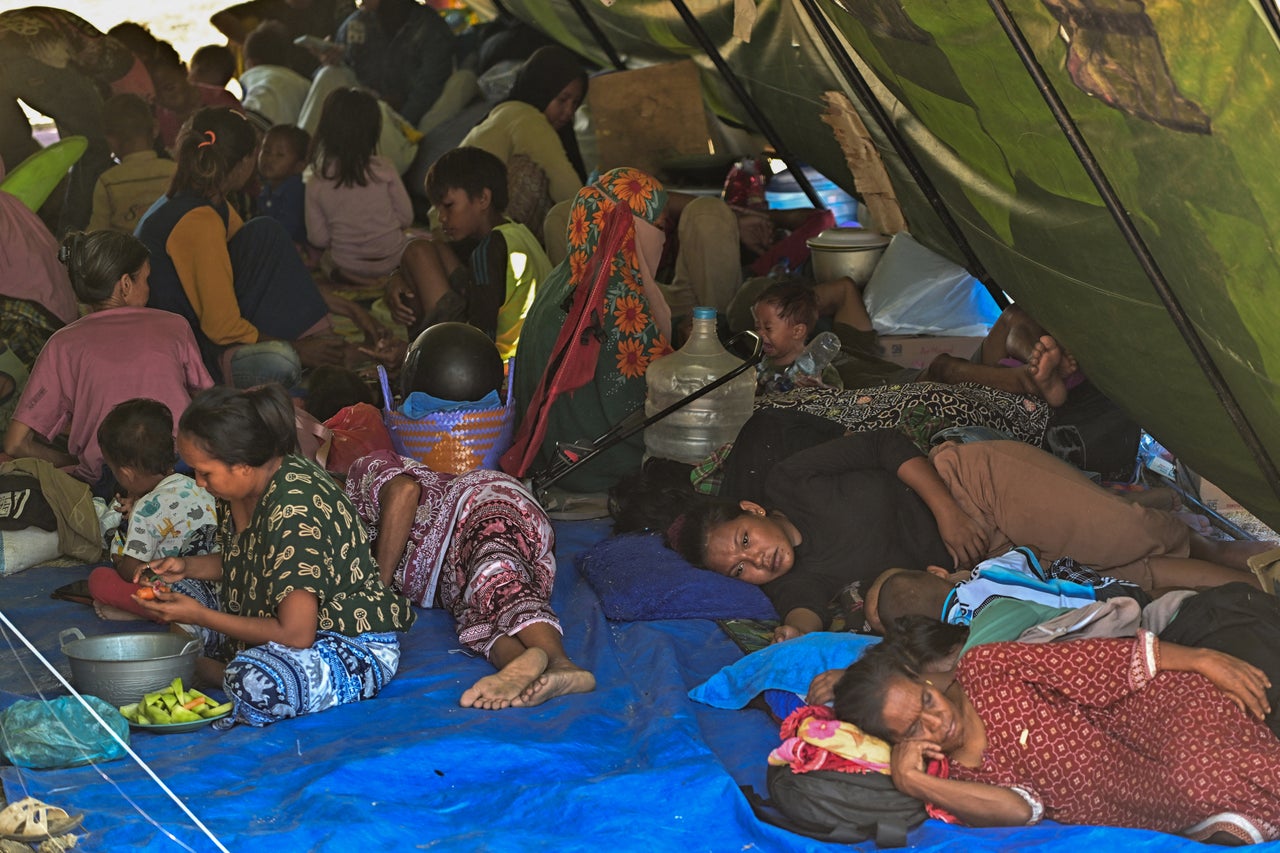
Villagers rest in a tent on an open field in Marapokot, Nagekeo, East Nusa Tenggara (AFP/Getty)
Thousands more spent Sunday night under tarpaulins beside their collapsed houses rather than risk going indoors.
More than 3,500 military and police personnel have been deployed and 275 tonnes of aid sent into the disaster zone, but the terrain has slowed deliveries to the worst-affected communities.
"We are continuing to collect reports of damage and casualties, but there are communication disruptions," said the East Nusa Tenggara police chief, Rudi Darmoko, who described severe structural damage and collapsed buildings, with power cuts hampering communications.
Landslides have blocked sections of the Trans-Flores highway in Ende regency, the road that runs about 435 miles across the island from Labuan Bajo to Larantuka. Rescue officials have warned the death toll could rise, with villages across six regencies buried or cut off, and the disaster agency has sent a helicopter to carry supplies and support possible evacuations.
"My house is just rubble now," Rasyid Jafar, a clothing trader in the village of Reo, the worst-hit part of Manggarai regency, told the . "We need food, medicine and clean water urgently."
Survivors say what has arrived is not enough to live on. "We have nothing left. Why isn't there a public kitchen?" Mariana Tewu, another Reo villager, told the news agency.
Local television showed patients being wheeled out of several hospitals as a precaution, with staff moving beds and oxygen cylinders outside and setting up temporary treatment areas.
Saturday's quake prompted a tsunami warning and sent coastal residents to higher ground before it was lifted when no significant change in sea levels was detected. Flores was struck by a tsunami after an earthquake in 1992 that killed about 2,500 people.
Indonesia sits on the Pacific Ring of Fire, the belt of seismic activity around the edges of the ocean, and records frequent earthquakes and volcanic eruptions. An earthquake on Sulawesi in 2018 killed more than 4,400 people, and the magnitude 9.1 quake off Sumatra in 2004 caused a tsunami that killed about 230,000 people across a dozen countries.
Source: “AOL Breaking”
